
October 2026 Blog
Images: Physitrack.
Do you ever notice that your head and shoulders tend to sit too far forward and that your upper back seems more rounded than it used to be? These postural issues are very common, particularly when a large part of the day is spent sitting in front of a computer or using a phone.
Posture is not simply a matter of “sitting or standing up straight.” It also depends on the mobility of certain joints, as well as the flexibility and strength of several muscles. Your chiropractor can determine the factors contributing to your postural issues and help you address them. With the Physitrack app, we can prescribe personalized exercise programs accompanied by instructional videos. As an example, here are four basic exercises that we commonly prescribe to help improve frequent postural issues. Before starting any exercise program, check with a healthcare professional to make sure it is appropriate for your condition.
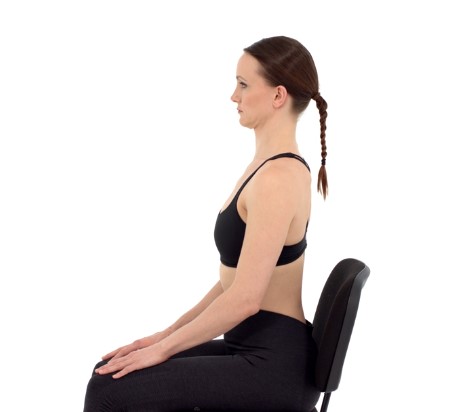
1. Chin Tucks
The first exercise is designed to reduce forward head posture. While sitting, with your shoulders relaxed and your gaze directed straight ahead, gently draw your chin backward, as if you were trying to create a “double chin.” Hold the position for 3 seconds, then relax. Perform 3 sets of 10 repetitions.
This exercise can also be performed standing against a wall, using a pool noodle placed between the back of your head and the wall. Position your heels approximately 30 cm (12 inches) from the wall. This variation may be helpful for some people because it makes it easier to feel the movement.
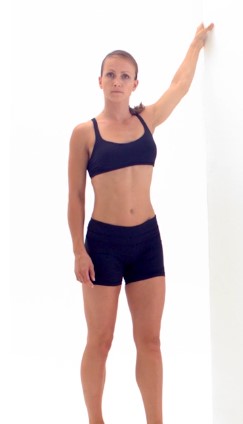
2. Pectoral Stretch
When the shoulders tend to roll forward, improving the flexibility of the pectoral muscles can also be beneficial.
For this exercise, stand perpendicular to a wall or in a doorway. Raise the arm on the side closest to the wall. Step forward with the leg on the same side and slowly rotate your chest away from the wall until you feel a stretch in the pectoral region closest to the wall. Hold the position for 20 seconds, 2 times on each side.
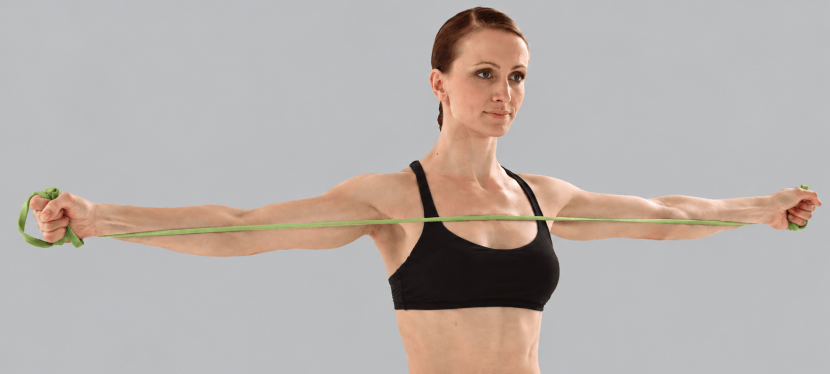
3. Rhomboid Strengthening
For this exercise, use a resistance band held with both hands. Start with your hands at shoulder height and in front of you, with slight tension on the band. Pull your arms backward as far as possible while keeping them horizontal. Then, without pausing, slowly return to the starting position while controlling the movement (approximately 2 seconds going backward and 2 seconds returning). Perform 3 sets of 10 repetitions. It is important to maintain good posture throughout the movement, with your chin tucked in and your natural lower-back curve maintained.
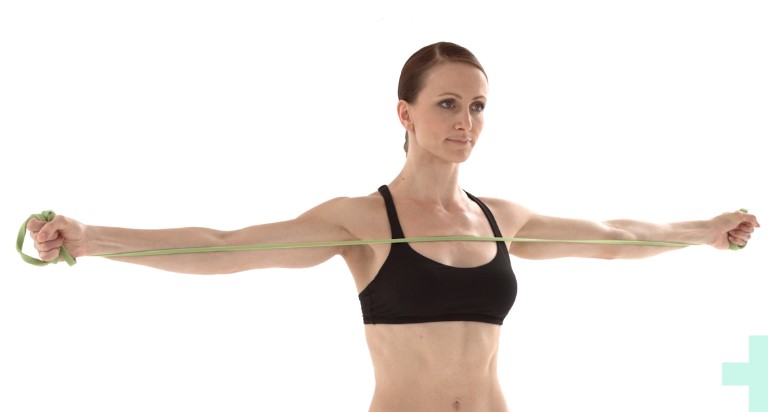
4. Scapular Retraction
The fourth exercise also focuses on strengthening the muscles that help bring the shoulders backward.
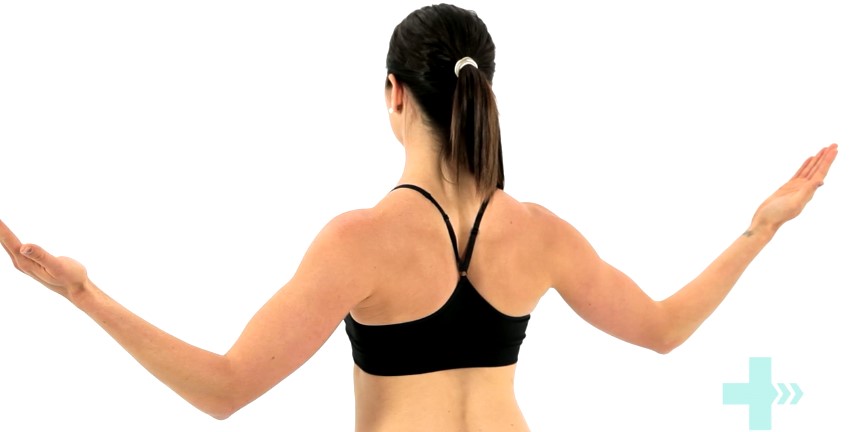
Start with your elbows bent at 90 degrees and held close to your sides. Then contract the muscles between your shoulder blades to bring your shoulder blades toward each other. Hold the position for 3 seconds, then relax. Perform 3 sets of 10 repetitions. As with the other exercises, it is important to maintain good posture throughout the entire movement.
Posture Cannot Be Corrected Through Exercise Alone
To improve your posture, it is also important to pay attention to it throughout the day and to improve your ergonomics when using a computer, a phone, and while driving, among other activities.
In addition, these exercises are not necessarily appropriate for everyone. Your chiropractor can adapt them to your specific condition. If you recognize yourself in a posture characterized by a forward head position, rounded shoulders, or an increased curvature of the upper back, talk to your chiropractor. An assessment can help determine which exercises and other recommendations are appropriate for you and how to incorporate them into your daily routine.
Stay in motion!

